If you’re a heavier rider, the best electric scooter for heavy adults is one rated well above your riding weight. Look for a high weight limit, a strong motor and big air-filled tires.
For the basics that apply to every rider, start with the electric scooter buying guide.
| Item | Value |
|---|---|
| Most common adult weight limit | 265 lbs |
| Median weight limit, scooters under $500 | 220 lbs |
| Median weight limit, scooters from $1,600 to $2,500 | 330 lbs |
| Median real-world range versus claimed range (175-lb rider) | 71% |
| Suggested capacity headroom above total riding weight | 20-25% |
The figures come from ERideHero’s weight-limit data and Gyroor’s heavy-rider guide. They can change as new models arrive and guidance is updated, so check the sources before you rely on them.
What does a weight limit actually cover?
The weight limit is the total load a scooter is rated to carry. That means your body weight plus clothes, helmet, backpack and anything else you bring, according to ERideHero. Treat the figure as total carrying capacity, not as a number for your body alone.
Most adult scooters are rated for 220 to 330 lbs, and 265 lbs is the most common, according to ERideHero’s data. The same database shows how the ratings cluster:
- 220 lbs: 14% of models, mostly budget commuters.
- 264-265 lbs: 38% of models, mainstream commuters.
- 330 lbs: 20% of models, performance scooters.
- 375-440 lbs: 4% of models, heavy-duty specialists.
Only a small group goes higher. According to ERideHero, a few dozen scooters exceed 330 lbs, the Emove Roadster is listed at 500 lbs, and Teewing lists 440 lbs for practically its entire lineup. If your riding weight is high, that heavy-duty tier is where your shortlist starts.
How much headroom should you leave?
Start by adding up everything you carry. Gyroor’s guide gives the example of a rider weighing 250 lbs with a 15 lb backpack, who needs a scooter rated for at least 265 lbs.
That total is the floor, not the goal. The same Gyroor guide says experts recommend a capacity at least 20-25% above your total riding weight, while Levy’s guide points to a 10% buffer rule. The two disagree, so treat the lower figure as a minimum.
For a rider around 250 lbs, a second Gyroor guide says a 265-lb scooter offers no real safety buffer. It suggests targeting 300 lbs or more.
Overloading has costs beyond the spec sheet. Levy’s guide says exceeding the limit reduces performance, creates safety hazards, accelerates component wear and can void your warranty. ERideHero adds that acceleration drops, the advertised top speed is out of reach and hills get harder.
Motor power and hills
Motor power matters more as rider weight climbs. Unagi’s guide says a scooter for heavy adults should have at least 500 Watts of motor power. Gyroor’s 250-lb guide gives the same 500W nominal minimum and suggests 800W to 1000W+ for a truly confident ride.
Capacity and power tend to rise together. In ERideHero’s database, scooters rated for 220 lbs have a median motor of 300 watts, against 2,700 watts for those rated at 330 lbs.
Dual motors help most on hills. Unagi’s guide says dual-motor scooters climb better, while single-motor models can still carry high loads but climb more slowly. Gyroor’s guide adds that continuous wattage matters more than peak wattage.
A companion guide to electric scooter motor power watts explains how to read these ratings.
Power also protects the motor. ERideHero explains that a motor pushed to its limit while moving slowly turns much of its power into heat, which can break down the winding insulation and burn out a hub motor.
Tires, frame, deck and brakes
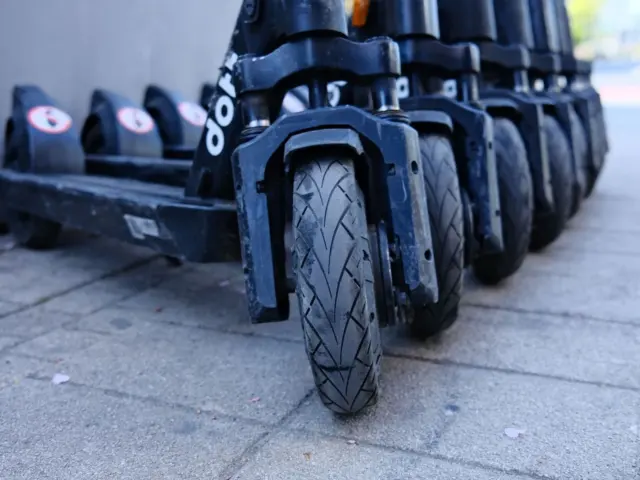
For heavy riders, Gyroor’s guide calls larger pneumatic tires of 10 inches or more superior. They absorb impacts better, add stability and give a larger contact patch for braking.
The same source notes that solid tires avoid flats but pass more shock to the frame and rider. For the full trade-off, read the comparison of pneumatic vs solid scooter tires.
Look closely at the frame too. ERideHero says the frame is the biggest stress point and where a scooter will typically fail.

Beyond the frame, check these details:
- Deck: Gyroor’s 250-lb guide recommends a deck at least 20 inches long by 8 inches wide for a stable stance.
- Brakes: the same guide says you need a dual braking system, ideally a front and rear disc brake.
- Fit: Unagi’s guide suggests looking at deck size, handlebar width and whether the stem adjusts for taller riders.
Range, battery and price
Claimed range is usually optimistic for a heavier rider. ERideHero range tested 96 scooters with a 175-lb rider and found a median of 71% of the claimed range.
The gap widens with weight. Gyroor’s 250-lb guide says a 250 lb rider should expect actual range 30-40% below the claim. Its other guide says a scooter advertising 40 miles for a 165 lb rider may only manage 20-25 miles for a 265 lb rider.
That makes battery size a priority. The same Gyroor guide suggests at least 15Ah, approximately 550Wh, for a practical commute range.
Price tracks capacity as well. This table shows the median weight limit by US price bracket in ERideHero’s database:
| Price bracket | Median weight limit |
|---|---|
| Under $500 | 220 lbs |
| $500 to $1,000 | 265 lbs |
| $1,000 to $1,600 | 294 lbs |
| $1,600 to $2,500 | 330 lbs |
| Over $2,500 | 330 lbs |
ERideHero also reports that 43% of scooters under $500 are rated at 220 lbs, and not a single scooter above $1,000 is (source). If you need more capacity than that, the budget tier is off the list.
Checking claims before you buy
Weight limits are self-reported. ERideHero notes there is no independent body to verify brands’ claims, and white-label scooters built from shared parts are a grey zone.
Europe has a test standard, EN 17128. It requires scooters to handle 2.5x their weight limit for at least 60 seconds without cracking, so a 265-lb scooter faces a 660-lb load. The US has no standard protocol, according to ERideHero.
Use this short checklist when you compare models:
- Add your weight to everything you carry.
- Choose a rated capacity with a clear margin above that total.
- Check the motor rating and prefer continuous watts over peak watts.
- Pick large pneumatic tires, a wide deck and dual brakes.
- Ask the brand for test evidence, and discount the claimed range.
Frequently asked questions
What is the most common weight limit on adult scooters?
Show answer
According to ERideHero, most adult scooters are rated for 220 to 330 lbs, with 265 lbs the most common.
Can you go over the weight limit once in a while?
Show answer
ERideHero says exceeding the limit by 10 lbs won’t instantly break a scooter, but consistently going over it is a bad idea. Performance, range and motor life all suffer.
Do heavier riders need a dual-motor scooter?
Show answer
Not always. Unagi’s guide says single-motor scooters can carry high loads, but dual-motor models climb hills better.
Do budget scooters work for heavier riders?
Show answer
Usually not. ERideHero says that if you need more than 220 lbs of capacity, you can rule out the budget category.