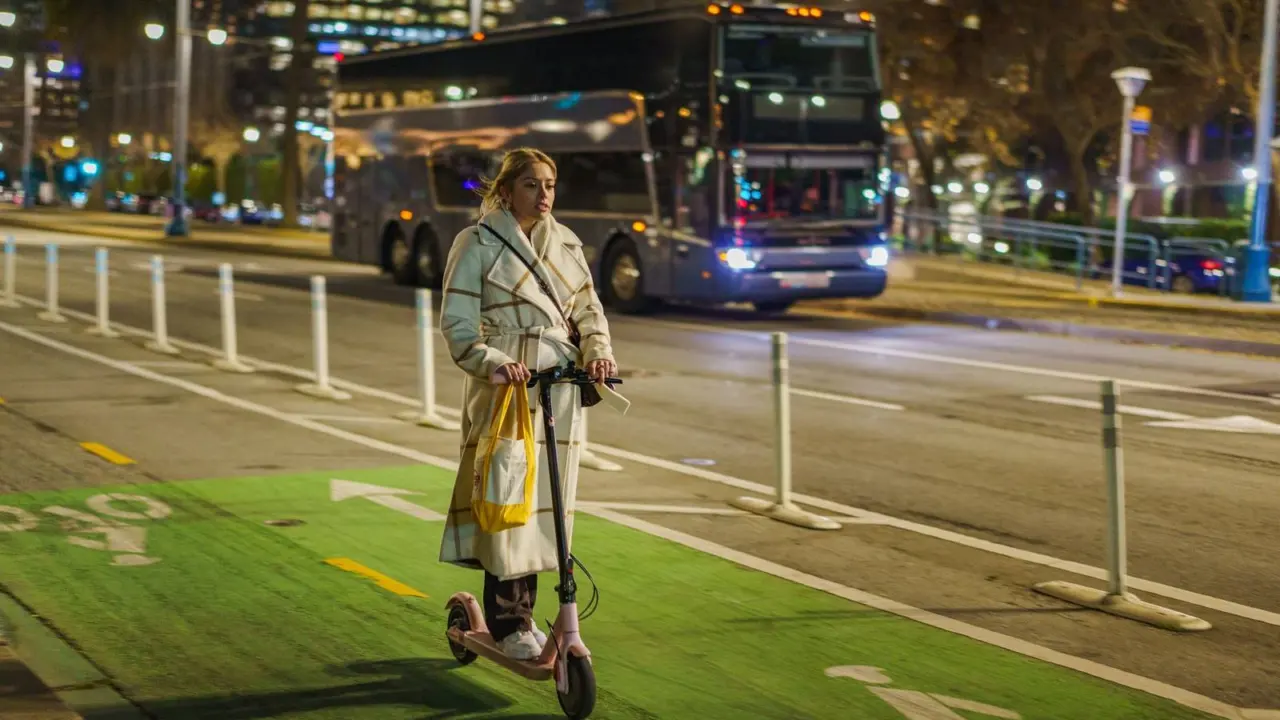
Can you ride an electric scooter on the sidewalk, or will you get fined? Usually not: most US rules send you to bike lanes or roads, and cities can be stricter. Check your local law first.
Sidewalk rules are one piece of the bigger picture covered in our guide to electric scooter safety rules.
| Item | Value |
|---|---|
| US states with statewide sidewalk bans (as of 2024-2025) | 17 states |
| California fine for sidewalk riding | $50-$200 |
| California maximum scooter speed | 15 mph |
| California streets where riding is permitted | Speed limit of 25 mph or less |
| Share of e-scooter injuries on sidewalks, as cited by Levy | 60% |
Figures come from Levy’s sidewalk rules guide and ERideHero’s state law map, whose data was last verified on February 13, 2026. Laws and fines can change, so check the source before you rely on them.
Sidewalks are usually off limits
For most of the United States, riding on the sidewalk is illegal unless local law specifically permits it, according to Levy’s guide, updated October 31, 2025. It counts 17 states with statewide sidewalk bans as of 2024-2025 and says many more let cities add their own limits.
The reasoning is pedestrian safety. The same guide says e-scooters can reach 15-20 mph, a real risk to people who expect a vehicle-free walkway. It also says recent studies show 60% of e-scooter injuries occur on sidewalks, which is best read as a scooter company’s claim rather than a settled statistic.
Walkers can step out without warning, so it pays to know how your scooter stops. Our notes on electric scooter braking safety cover that side of the question.
Here is how several places treat sidewalks, based on Levy’s guide updated October 31, 2025, ERideHero’s data last verified February 13, 2026, and a Slashgear article dated Nov. 4, 2025:
- California: ERideHero lists sidewalks as prohibited except as needed to enter or leave adjacent property, and crosswalks count as sidewalks. Levy gives fines of $50-$200.
- New York: Levy calls sidewalk riding strictly illegal, including in New York City, where enforcement can mean fines, impoundment and in some cases criminal charges.
- Florida: Levy says streets and bike paths are allowed but sidewalks are explicitly prohibited.
- Arkansas: ERideHero says riding on sidewalks is generally prohibited statewide, and local authorities may regulate further.
- Delaware and Pennsylvania: Slashgear reports that Delaware prohibits e-scooters on all public streets and sidewalks, and that Pennsylvania has not defined them, so they are illegal everywhere.
Can you ride an electric scooter on the sidewalk when state and city rules clash?
Levy’s second guide, updated January 23, 2024, describes three layers of law that apply to you at once:
- Federal: it defines what an e-scooter is but does not regulate where you can ride.
- State: most states have laws on allowed riding locations, speed limits, age requirements and helmets.
- City: cities can add restrictions beyond state law, but not remove them.
In practice, the strictest rule always applies, so a city ban beats a relaxed state law. Slashgear notes that in states like California and Illinois, local authorities can supersede state ordinances, and Libertyville, Illinois, banned e-scooters outright.
Published sources also disagree. Levy’s guide lists Colorado among the states with explicit sidewalk bans, while ERideHero, as of its February 13, 2026 verification, says Colorado allows sidewalk riding unless local ordinance restricts it. That gap is a good reason to treat local rules as the final word.
Slashgear’s advice is to drill down to the precise local level where you ride. Levy adds that the default assumption should be that sidewalk riding is prohibited until you have confirmed it is allowed in your area.
Bike lanes and roads: where you are usually told to ride
Per Levy’s guide updated January 23, 2024, nearly all states that regulate e-scooters direct riders to use bike lanes when available. ERideHero lists California as requiring bike lane riding if one is available.
Levy describes how different kinds of bike infrastructure are treated:
- Painted lanes: usually permitted for e-scooters.
- Buffered and protected lanes: permitted in most jurisdictions, and protected lanes are often preferred by riders.
- Shared-use paths: usually permitted, but check local signs.
When there is no lane, the road is the usual fallback. Levy says some states require you to use the road rather than the sidewalk even when no bike lane exists.
The speed limit of the road can decide the matter. Slashgear says Michigan bars e-scooters from roads with a speed limit above 25 mph, while Oklahoma’s limit is 35 mph. In California, ERideHero says streets with limits of 25 mph or less are permitted, and streets up to 35 mph only inside a bikeway unless a local ordinance says otherwise.
Your scooter’s own top speed is regulated separately, and ERideHero lists California’s maximum at 15 mph. Our page on the electric scooter speed limit goes into that detail.
Where sidewalk riding can be allowed
Not every place bans it. Unagi’s guide, updated on 10/28/2024, says that where scooters are allowed but there are no bike lanes or shared paths and no highway use, sidewalk riding might be permissible, particularly if pedestrian traffic is low.
Arizona is one US example. As of ERideHero’s February 13, 2026 verification, ERideHero lists Arizona sidewalk riding as generally allowed unless prohibited locally, and riders must yield to pedestrians.
Outside the US, rules differ again. Unagi’s guide, updated on 10/28/2024, reports the following:
- Queensland, Australia: scooters are allowed on footpaths at a maximum of 12 km/h as long as no signs prohibit them.
- Western Australia: scooters can use footpaths but must keep to 10 km/h.
- Tasmania: as of December 1, 2021, scooters are allowed on footpaths.
- Tallinn: scooters are permitted on both sidewalks and bike lanes.
- London and Berlin: London bans sidewalk riding even for rental scooters, and Berlin forbids it on sidewalks and in pedestrian zones.
Where it is allowed, pedestrians still come first. Parking matters too: Unagi warns that improperly parked scooters become hazardous obstacles, and ERideHero notes that California riders must not park blocking a pedestrian path.
How to decide where to ride
Unagi’s guide, updated on 10/28/2024, suggests working through your options in a set order. Its logic adapts well into a short checklist:
- Look up your local rules, such as your Department of Motor Vehicles or city ordinances.
- Use a bike lane if there is one nearby, especially at rush hour when foot traffic is heavy.
- If there is no lane, check whether you can legally and safely use the road.
- Treat the sidewalk as a last resort, and only where local law allows it.
- Watch for prohibition signs, since owners must police themselves.
Rental riders may get some help. Unagi says rental scooters often have detection features that limit speed or emit warnings in areas where scooters might not be permitted, such as sidewalks.
Frequently asked questions
Can I ride on the sidewalk if there is no bike lane?
Show answer
Often not. Levy says some states require the road rather than the sidewalk even when no bike lane exists, so check your city’s rules before you decide.
What happens if I am caught riding on a sidewalk?
Show answer
Levy gives California fines of $50-$200, and says New York City enforcement can include fines, impoundment and in some cases criminal charges. Penalties differ by place.
Are crosswalks treated like sidewalks?
Show answer
In California they are. ERideHero, with data verified February 13, 2026, says crosswalks are considered sidewalks there, so riding in them is prohibited. Check how your own area treats them.
Do rental scooters follow different rules?
Show answer
The rules about where you ride come from local law. Unagi says rental scooters often have detection features that limit speed or warn you in areas where scooters might not be permitted.