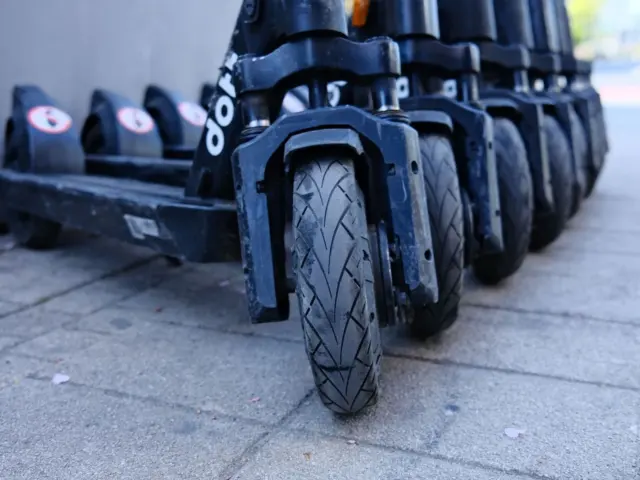
Worried you’ll buy a scooter that’s too heavy, too slow or dies halfway home? Here’s how to choose an electric scooter: match weight, range, power and safety certification to your actual route, then test-lift it.
This page narrows the wider electric scooter buying guide into a step-by-step route.
| Item | Value |
|---|---|
| Heaviest scooter most apartment riders can carry | Under 30 kg (about 66 lb) |
| Range to plan for versus the advertised claim | 30-50% less |
| Typical motor for general commuting and mild hills | 350-500W |
| Speed limits in many U.S. cities and states | 15-20 mph |
| Electrical safety standard to look for | UL 2272 |
The figures come from GreenMoov’s urban rider guide (last updated September 19, 2026) and Levy’s beginner buying guide. They can change, so check the source before you rely on them.
Start with your route, not the spec sheet
Write down your route before you open a product page. GreenMoov suggests noting your daily distance (5-15 miles), whether there are hills, stairs and where the scooter will be stored indoors, as its guide explains.
- Measure the round trip, not only the one-way distance.
- Note hills, stairs and where the scooter sleeps at night.
- Check your city’s scooter speed cap and helmet rule.
- Decide whether a scooter or an e-bike suits your trips better.
Distance adds up faster than most people expect. GreenMoov points out that if work is 4 miles away, your day is already 8 miles before errands.
The scooter-or-e-bike question is worth settling early. In the same guide, scooters win on fold-and-carry for short urban hops, while e-bikes usually win on saddle comfort, extra range and steep loaded climbs, at the cost of weight.
Can you carry it? Weight and portability
Weight is the first filter if stairs, trains or buses are part of your day. GreenMoov says a scooter over 30 kg (about 66 lb) fights you on stairs, into elevators and onto a crowded bus.
Lighter targets are stricter. Gyroor’s buyers guide calls models under 30 lbs ideal for multi-modal travel, while NBC Select’s April 28, 2025 roundup says its reporter considers any electric scooter under 35 pounds light.

If you carry the scooter every day, a lightweight foldable electric scooter is the category to study first. Whatever you shortlist, check that the folded stem clears your closet and stairwell.
How far will it really go? Range
Advertised range is a best case. GreenMoov says to plan for 30-50% less than the claim, and Gyroor’s guide puts real-world range at typically 50-70% of the claimed figure.
Leave a cushion on top of that. Gyroor also says your required range should exceed your round-trip distance by at least 30% to account for battery degradation over time, headwinds and colder weather, as its guide notes.
Riding mode changes the maths too. GreenMoov says sport mode can jump consumption by 40% or more, so save it for a short merge rather than the whole commute.
Read range next to weight. NBC Select’s April 28, 2025 roundup lists the Gotrax Gmax Ultra with an estimated range of up to 45 miles and a weight of 46 lbs, a reminder that “up to” is a ceiling, not a promise.
- Ask for watt-hours when a listing only shouts miles.
- Check whether you can charge at work, which changes the battery you need.
- Keep tyre pressure up, because low pressure also spends battery.
Motor power and speed
Match motor power to your weight and terrain. Levy’s beginner guide breaks it down like this:
- Flat terrain, rider under 175 lbs: 250W, about 15 mph top speed, struggles on hills.
- General commuting, mild hills: 350-500W, 15-20 mph, handles moderate inclines.
- Hilly area, rider over 180 lbs: 500-1,000W, 20-25 mph, comfortable hill climbing.
The same guide gives a rule of thumb: you need roughly 15 to 20 watts per kilogram of your body weight for decent hill climbing, as Levy explains. For steeper routes, GreenMoov suggests looking for a grade claim around 15-20%, though it calls brochure icons weak evidence.
Top speed matters less than the legal limit where you ride. GreenMoov notes that many U.S. cities and states that write e-scooter rules land between 15 and 20 mph, and advises staying in the 15-25 mph class unless you have private pavement and a reason.
Safety certification, tyres and brakes
Look for UL 2272 on the spec sheet. GreenMoov prefers devices evaluated to UL 2272 for personal e-mobility electrical systems, and NBC Select’s April 28, 2025 roundup only considered scooters certified to that standard.
As of GreenMoov’s September 19, 2026 update, New York City requires third-party certification for e-scooters, e-bikes and light EV battery packs, per its guide. Rules differ by city, so check yours.
Good charging habits go with a certified pack. The same guide says not to charge on a sofa, not to run a swollen pack, and to walk away if the seller can’t show a certification mark.
A few ride-feel checks round out the list:
- Tyres and suspension: GreenMoov says 10-inch tires and dual suspension take the edge off potholes.
- Brakes: dual braking beats a single weak e-brake.
- Visibility: a headlight plus a brake light does more at dusk than a dark silhouette.
Your pre-purchase checklist
Turn the steps into a one-page spec sheet. Copy the weight, claimed range, watt-hours, motor rating, top speed, grade and certification, then cut the range 30-60% and compare the result to your round trip plus a buffer, as GreenMoov recommends.
Then try before you buy. The same guide says to go to a shop if you can, test the stem flex, and try the brake lever with the gloves you wear.
If your goal is a daily ride to work, the best electric scooter for commuting page narrows the field by use case.
Avoid these common mistakes:
- Buying for top speed when many local limits sit at 15-20 mph, per GreenMoov.
- Trusting the sticker range without a discount.
- Ignoring weight until the first flight of stairs.
- Skipping the certification mark.
Frequently asked questions
How heavy should an electric scooter be if I carry it?
Show answer
Under 30 kg (about 66 lb) is the ceiling GreenMoov gives for apartment riders. Gyroor calls models under 30 lbs ideal for multi-modal travel.
How much range do I need?
Show answer
Plan for 30-50% less than the advertised claim, per GreenMoov. Gyroor adds that range should exceed your round trip by at least 30%.
Do I need a 500W motor?
Show answer
Not always. Levy’s guide lists 350-500W for general commuting and mild hills, and 500-1,000W for hilly areas or riders over 180 lbs.
What does UL 2272 cover?
Show answer
According to GreenMoov, it evaluates electrical systems on personal e-mobility devices. It is not a riding-skill certificate.